Most IT failures don’t just show up out of nowhere. There were usually some warning signs, they just got missed. IT systems these days are way more complex, so even a small server or network issue can turn into a real problem if nobody catches it in time. That’s basically why companies use NOC (Network Operations Center) services, someone’s watching things constantly, so small problems get caught early instead of turning into bigger ones.
In 2026, that is not just a bad night. That is a financial emergency.
Research across the industry shows that more than 90% of organizations say a single hour of network downtime costs them upward of $300,000. And with IT environments getting more complicated by the day, spread across multi-cloud setups, SD-WAN, remote teams, and edge computing, there is almost no room left for things to go wrong.
That is the reality that has pushed NOC services from a nice-to-have into something enterprises genuinely cannot afford to operate without. It is not a luxury item on the IT budget. It is a core part of keeping the business running.
This guide covers everything worth knowing about NOC services. What they actually are, how they work in practice, what a solid provider includes, how managed and in-house approaches stack up against each other, and how to find the right Network Operation Center partner for where your organization is today.
What Are NOC Services?
NOC services, which stands for Network Operations Center services, are the ongoing, around-the-clock monitoring, management, and maintenance of everything that makes up an enterprise’s IT network infrastructure.
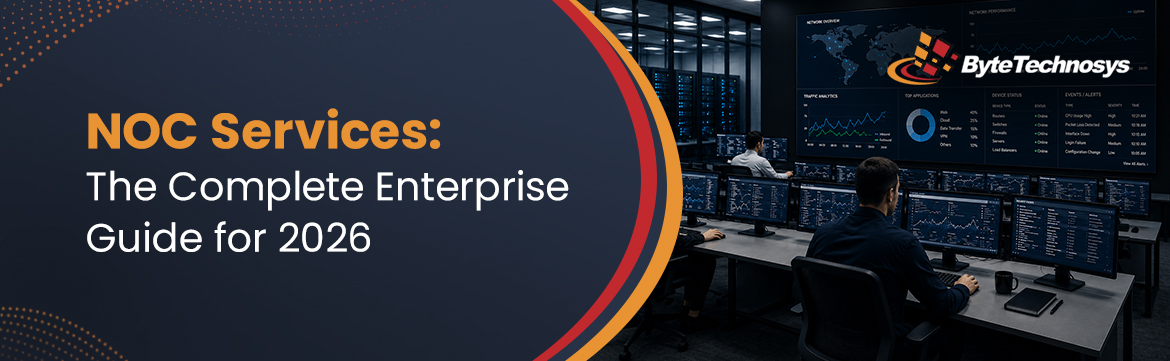
Picture the Network Operation Center as a central command room where skilled IT engineers are always keeping an eye on your networks, servers, applications, firewalls, cloud workloads, and endpoints, every hour of every day, throughout the entire year.
What makes NOC monitoring different from the way traditional IT support works is this: the NOC finds and fixes problems before they ever surface to your users. Traditional support waits for something to break and someone to report it. A good NOC makes sure that report never needs to happen in the first place.
By 2026, that work covers a lot of ground. It means continuous monitoring of every endpoint and environment around the clock. It means real-time incident detection that can tell the difference between genuine problems and background noise. It covers patch cycles and change management to keep everything secure and up to date. It includes keeping a close watch on backup and disaster recovery so business continuity stays protected. It extends into cloud environments across AWS, Azure, and Google Cloud. It produces real performance data on uptime and latency tied to your SLAs. It digs into the root causes of problems so history does not keep repeating itself. And when security events pop up, it gets the right people involved immediately.
Why Enterprises in 2026 Cannot Treat NOC Services as Optional
Three years ago, enterprise IT infrastructure looked completely different. Today it stretches across on-premises data centers, several public clouds at once, SaaS applications, employees working from dozens of locations, and edge computing deployments running in parallel.
Staying on top of all of that, with the consistency and expertise the job actually demands, is more than most internal IT teams can realistically take on.
Look at where the market is. The global NOC-as-a-Service market was worth $3.67 billion in 2025 and is expanding at a 10.2% CAGR. North America makes up more than 36% of that, driven by cloud growth and increasing compliance pressure. AIOps-driven NOC platforms already hold a 30% market share and are changing the way incidents get caught and handled. The overall Network Operation Center market is expected to cross $65 billion by 2033. More than 92% of the world’s top 2,000 IT companies have already moved at least some of their operations to outside partners.
For enterprises operating in the United States, the compliance angle makes all of this even more pressing. Healthcare has HIPAA to answer to. Financial services firms carry SOC 2 and PCI-DSS obligations. Government contractors work inside NIST frameworks. All of those requirements mean someone needs to be watching the network continuously and documenting everything, and that is precisely what a properly run NOC does.
How a Network Operation Center Actually Works Day to Day
Understanding how a NOC operates helps you ask better questions when you are evaluating providers and gives you a clearer sense of what you are actually getting.
Here is how the work flows from start to finish.
Step 1: Continuous NOC Monitoring
Using enterprise-grade monitoring platforms, NOC engineers pull live telemetry data from every device and workload in your environment. Routers, switches, firewalls, servers, virtual machines, cloud instances, endpoints, everything. The moment any of it starts behaving differently from its established baseline, an alert goes out.
Step 2: Alert Triage and Correlation
This is where a lot of providers separate themselves from each other. Not every alert means something is actually wrong. A mature NOC team applies correlation rules, topology mapping, and machine learning to sort out what genuinely needs attention from what is just noise. The noise-to-action ratio is one of the best indicators of whether a NOC is actually doing its job. If a provider just forwards everything to your team without filtering it first, they are not solving a problem for you. They are creating one.
Step 3: Incident Response and Resolution
When a real incident is confirmed, engineers work through runbooks that were built around your specific environment. Routine issues stay at Tier 1. More complex situations move up to Tier 2 or Tier 3, with the full history of what has happened already written down. Nobody starts from zero. Nobody spends the first 20 minutes of an outage getting up to speed on what already happened.
Step 4: Escalation and Client Communication
Some situations go beyond what the NOC can close on their own. When that happens, your internal team or the right specialist gets brought in, but they receive everything already packaged together. What was found, what was tried, and what the recommended path forward looks like. A well-run NOC always has a clear documented answer to the question that matters most at 3 AM: who do we call and what do we tell them?
Step 5: Reporting and Continuous Improvement
Every resolved incident becomes a post-incident report, an SLA summary, a data point in a longer trend. Over time those data points reveal the patterns, the recurring weak spots, the places where infrastructure is quietly aging. What started as an operational log becomes something you can actually use to make better decisions about where to invest and what to fix.
What a Managed NOC Service Should Actually Include
When you are sitting across from a managed NOC provider, here is the full picture of what a serious offering should cover:
| Service Area | What to Expect |
|---|---|
| Network monitoring | Around-the-clock oversight of LAN, WAN, SD-WAN, and wireless |
| Server monitoring | CPU, memory, disk, and process-level visibility |
| Cloud infrastructure monitoring | AWS, Azure, and GCP workloads watched alongside on-premises systems |
| Application performance monitoring | Response time tracking tied to your SLA commitments |
| Backup monitoring | Confirmation that backup jobs are actually completing |
| Patch and change management | Firmware and software updates to close security gaps |
| Firewall and security monitoring | Anomaly detection with clear SOC escalation paths |
| SLA and performance reporting | Regular uptime, MTTR, and incident trend data |
| Disaster recovery support | Hands-on coordination and testing of recovery procedures |
In-House NOC vs Managed NOC Services: A Straight Comparison
Many IT teams assume their internal coverage is good enough. The honest reality is that ad-hoc internal monitoring and a purpose-built, always-on Network Operation Center are very different things, and the gap between them tends to show up at the worst possible moments.
| Factor | In-House NOC | Managed NOC Services |
|---|---|---|
| Coverage hours | Business hours with on-call backup | 24/7 * 365 with no gaps |
| Staffing cost | $110,000 to $148,000 per engineer fully loaded, US market | One predictable monthly fee |
| Tool investment | CeSignificant upfront capital cost | Bundled into the service |
| Scalability | Slow, tied to hiring and onboarding timelines | Immediate, adjust up or down as needed |
| Expertise depth | Generalist IT knowledge | Specialists in network, cloud, and security |
| Compliance documentation | Inconsistent and often manual | Structured, repeatable, and audit-ready |
| Response time | Depends on who is available | Defined by SLA |
Deloitte’s research puts the cost reduction from moving to managed services somewhere between 25 and 45 percent on average. For NOC specifically, outsourcing typically cuts operational costs by 40 to 60 percent versus building an in-house operation with comparable capabilities.
Cyberattacks and infrastructure failures do not schedule themselves around your team’s working hours. A small internal team with multiple competing priorities cannot realistically provide the same depth of coverage that a NOC running around the clock is built to deliver.
Which Organizations Actually Benefit from NOC Services?
This is not a solution reserved for the largest companies in the world. In 2026, organizations across a wide range of sizes and sectors are seeing strong returns from NOC investments.
Enterprise IT teams managing hybrid or multi-cloud environments get the 24/7 coverage they need without running their internal people into the ground on overnight schedules. Healthcare organizations keep HIPAA-compliant visibility running across clinical systems, EHR platforms, and connected medical devices at all times, because there is no acceptable period of blindness in that environment. Financial services firms get SOC 2 and PCI-DSS-aligned monitoring with the kind of documentation that actually stands up during regulatory examinations. MSPs can grow their client base without needing to hire in proportion to that growth, because white-label NOC services let them extend enterprise-grade monitoring under their own name. E-commerce and SaaS companies protect themselves from downtime that directly translates into lost revenue, abandoned shopping carts, and customers who do not come back. And telecom and infrastructure companies with large, geographically spread networks need the kind of sustained expert coverage that only a dedicated team can provide over the long haul.
NOC Services and SOC Services: What Is the Actual Difference?
It is one of the most common questions that comes up in conversations with enterprise IT leaders: do we need both an NOC and a SOC?
The honest answer is yes, but it helps to understand why they are not the same thing.
NOC is built around keeping your network healthy. Performance, availability, uptime, that is its entire focus. It exists to stop disruptions before they happen and to resolve them quickly when they do. A SOC is built around security. Its job is threat detection, active response to security incidents, and digging into suspicious events to understand what happened and what it means.
One way to frame it: the NOC keeps the lights on and the SOC keeps the building safe. The most resilient enterprises in 2026 run both. NOC monitoring data often surfaces anomalies that feed directly into SOC investigations, which creates an integrated operations model where availability and security are both being managed together rather than separately.
If you have to start with just one, NOC monitoring builds the foundational visibility layer that everything else, security operations included, is built on top of.
The Metrics That Actually Tell You If Your NOC Is Working
Once your NOC is up and running, you need a way to know whether it is genuinely delivering value. These are the numbers to watch.
Mean Time to Detect measures how quickly incidents get caught after they happen. The lower this number, the better. Strong NOC operations are catching problems within seconds or minutes.
Mean Time to Resolve tracks how long it takes from the moment something is detected to the moment it is fully fixed. When this number steadily decreases over time, that is the sign of an operation that keeps getting better.
First-Call Resolution Rate is simply about how many problems the NOC closes on their own without ever needing to loop in your internal team. The higher that number, the more confident you can be that the triage process is actually working the way it should.
Network Uptime is exactly what it sounds like, how consistently your infrastructure stays available compared to whatever target your SLA sets, which for most organizations sits at 99.9% or above.
The Alert-to-Incident Ratio is worth paying close attention to because it tells you whether your NOC is genuinely filtering out the noise or just passing everything along. When that number creeps up, it usually means your people are burning time chasing alerts that never amounted to anything real.
SLA Compliance Rate tracks how consistently incidents are being resolved within the timeframes your contract defines. It is the clearest measure of whether the engagement is delivering on its promises.
Before committing to any provider, ask to see their real historical data on MTTD, MTTR, and SLA compliance. A provider that stands behind their work will have those numbers ready without hesitation.
What to Look for When Choosing a NOC Services Provider
This is one of those decisions that reaches into your uptime numbers, your compliance posture, and the day-to-day experience of your internal IT team. Here is what genuinely matters when you are working through your options.
Start with real 24/7/365 coverage. Ask specifically about nights, weekends, and public holidays. Find out what the staffing ratios look like on overnight shifts and what the procedure is when a key engineer is unavailable.
Push every provider on whether they do proactive operations or just alert forwarding. The difference matters enormously. A provider sending every alert straight to your team without filtering is adding noise, not providing a service. Ask what their noise-to-action ratio looks like and how they handle correlation.
Transparency around dashboards should be a baseline expectation, not a premium feature. You should have live access to the same view your NOC engineers have. Needing to request a report to check the health of your own network is a red flag.
Environment-specific runbooks tell you whether a provider has actually invested time in understanding how your infrastructure works, or whether they are running you through a generic template built for someone else. Escalation paths, recovery procedures, change workflows, all of it should reflect your specific environment.
Compliance expertise is something US enterprises need to test carefully. Surface-level familiarity with HIPAA, SOC 2, PCI-DSS, and NIST is not enough. That documentation is going to face scrutiny during audits, and your provider needs to be ready for it.
Integration with what you already use is non-negotiable. ServiceNow, Jira, Splunk, CloudWatch, Azure Monitor, Datadog, whatever tools your team runs on, your NOC partner should work within that ecosystem without forcing you to rebuild anything.
And look for flexibility in how engagements are structured. Tiered service levels, per-device pricing, and the ability to scale up or down without renegotiating the entire contract every time your infrastructure changes.
What Is Actually Changing in the NOC Space: AIOps and Predictive Operations
The NOC that existed five years ago and the NOC of 2026 are genuinely different operations. The shift away from reactive monitoring toward something more like predictive intelligence is well underway, and the pace is not slowing down.
Modern AI-driven platforms can spot patterns long before they cause a service impact. A fiber link that is slowly degrading. A CPU that has been quietly climbing toward its limit. Traffic volumes that are starting to look unusual. These systems identify those signals and act on them before anything breaks. That approach, broadly called AIOps, held 30% of the global NOC market in 2025 and is the part of the market growing fastest.
Automation handles the repetitive remediation work: service restarts, DNS failover, certificate renewals. That frees up the engineers to focus their attention on the problems that actually require judgment and experience.
For any enterprise making a decision about NOC services in 2026, AIOps is not a bonus capability to negotiate for. It is quickly becoming the floor-level expectation.
How ByteTechnosys Approaches NOC Services
ByteNOC at ByteTechnosys was built for enterprises that need real, uncompromised uptime across IT infrastructures that span multiple environments and keep getting more complex.
Our engineers provide 24/7 coverage across cloud, on-premises, and hybrid environments. Every engagement is supported by structured escalation runbooks, live visibility dashboards, compliance-ready reporting, and AIOps-powered alert correlation that genuinely reduces noise rather than passing it along.
We are not just watching your infrastructure. We work as an extension of your IT team, catching incidents before they escalate, staying on top of patch cycles, coordinating disaster recovery, and delivering the kind of steady, reliable performance that lets your business operate the way it should.
Whether your organization is an enterprise building a more resilient IT foundation, an MSP looking to grow without proportionally expanding headcount, or a company in a regulated industry that needs network oversight aligned to HIPAA and SOC 2, ByteTechnosys has the depth and the experience to meet you where you are.
If unplanned downtime is something your organization can no longer afford to accept, Get in touch with ByteTechnosys today and let our NOC team put together a monitoring strategy built around your environment.
Frequently Asked Questions About NOC Services
What is the difference between NOC services and IT helpdesk support?
A NOC watches your infrastructure continuously and acts before problems affect users. A helpdesk responds after users report that something is wrong. In most cases, a well-run NOC catches and resolves the issue before it ever becomes a helpdesk ticket.
How much should managed NOC services cost?
Cost depends on the size of your environment, the scope of coverage, and which service tier fits your needs. Most providers price per device or per endpoint. Compared to staffing and running an equivalent in-house operation, managed NOC services typically cost 40 to 60 percent less.
Will NOC services work with the tools our team already uses?
Yes. Any provider worth working with will integrate with the platforms your team relies on, including ServiceNow, Jira, Splunk, Datadog, CloudWatch, and Azure Monitor.
Do we really need both a NOC and a SOC?
For most enterprise environments, yes. The NOC handles infrastructure availability and performance. The SOC handles security threats and incident response. Each covers gaps the other leaves open.
Which types of organizations see the most value from NOC services?
Healthcare, financial services, e-commerce, telecom, MSPs, and enterprises running hybrid or multi-cloud environments where downtime has a direct, immediate cost to the business.
ByteTechnosys is an IT infrastructure management company delivering NOC services, cloud infrastructure management, helpdesk support, and disaster recovery solutions for enterprises globally. Learn more at bytetechnosys.com

Ravi Patel is a team lead in the Managed Workplace division at ByteTechnosys with over 11 years of experience in IT infrastructure, managed services, and workplace technology solutions. He specializes in Microsoft 365 administration, Windows and Linux server management, cloud services, web hosting, and IT operations, with a passion for delivering reliable technology solutions. Ravi shares practical insights, industry best practices, and real-world expertise to help organizations secure digital workplaces.